
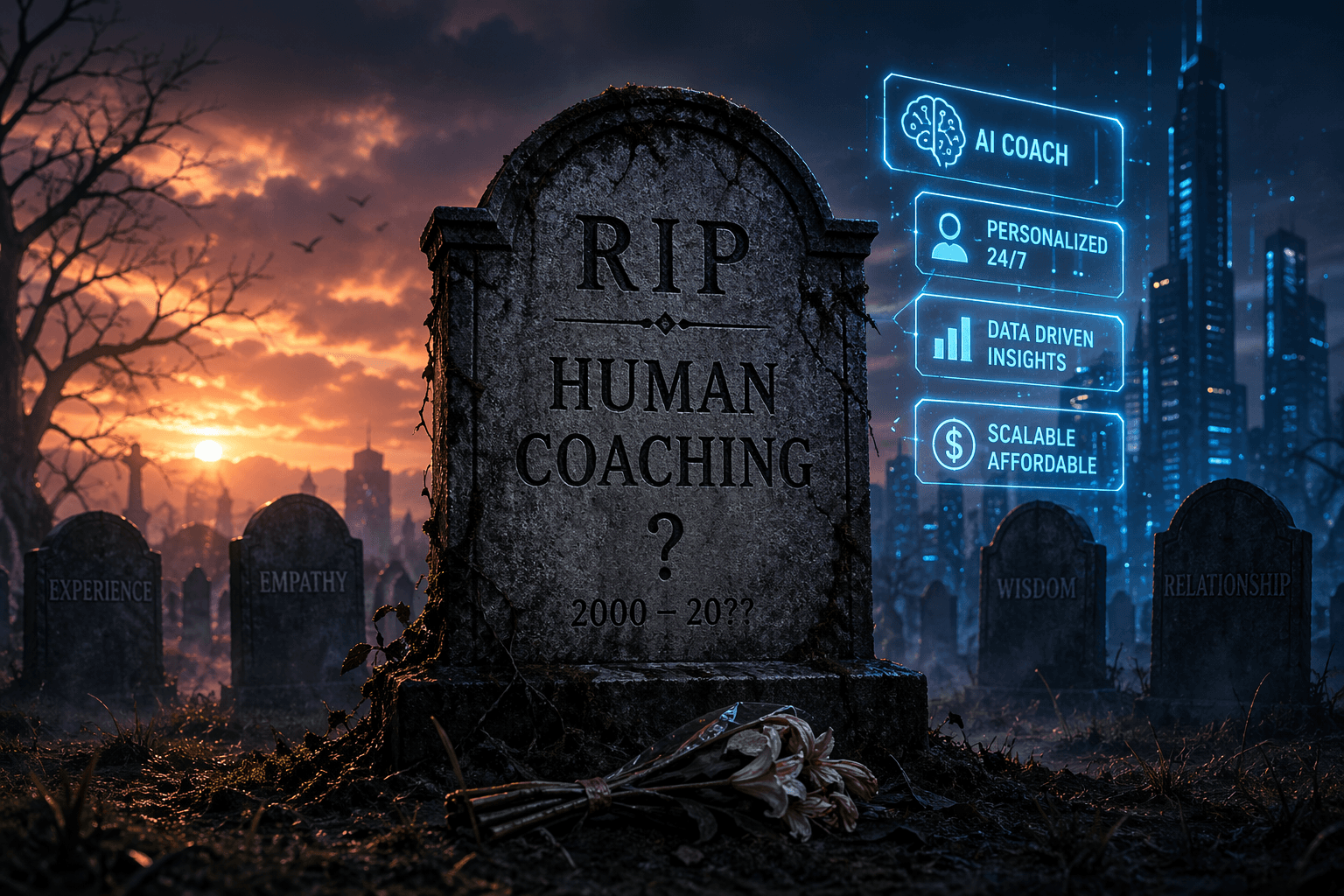
Will AI and Commoditisation End Human Coaching?
24 April 2026
Note: The following article was also published on LinkedIn. If you'd like leave a comment, then please head over to LinkedIn here
As a coach, coach trainer, and coaching supervisor, my livelihood, like many others, is dependent on the coaching industry. Yet, how many of us have stopped to consider where the coaching industry is heading, and what might that mean for our future? It’s much easier to keep the head down, do what we’ve always done, and follow the crowd.
Realising that I’ve been guilty of this, I recently contemplated the future direction of the coaching industry for myself. I was curious about how this could impact my company and what changes I might need to make to remain relevant.
Given the present level of disruption within the world, this activity felt more important and timely than ever before. Not only are we facing technological disruption from AI, coaching and psychotherapy are increasingly overlapping, and coaching bodies continue to professionalise the coaching industry. At the same time, the current political, geopolitical, technological and climate disruptions – resulting in division, intolerance, and fear – illustrate the need for coaching has never been greater.
From my contemplations, I realised I was potentially seeing the demise of the coaching profession as we know it today. A demise not only brought on by AI but also by the professional coaching bodies and a drive towards commoditisation.
I also recognised that my original views on AI coaching were flawed, or at the very least, influenced by traditional market responses to such disruptions.
The Innovators Dilemma
My contemplations started with the work of Clayton Christensen, who authored a book called The Innovator’s Dilemma in 1997. This work explores why companies fail to stay atop of their industries when faced with market or technological disruption. Given the many differing opinions about how AI is, will, or has the potential to disrupt the coaching industry, Christensen’s work seemed like an appropriate lens.
Rather than analysing any particular coaching provider, I took the principals of Christensen’s work and applied them to holistically to the coaching industry. By coaching industry, I’m referring to the industry that is self-regulated by any of the main coaching professional bodies – of which there are several. In particular, I’m focusing on the two I’m most familiar with, the International Coaching Federation (ICF), and European Mentoring and Coaching Council (EMCC).
Sustaining technologies
Both the EMCC and ICF have worked to professionalise the coaching industry by defining standards and competencies, along with ethical frameworks, credentialling of coaches, and accreditation of coach training providers. These are essentially what Christensen would refer to as sustaining technologies – they offer incremental improvement over time. Consider how, as an example, competency frameworks have been periodically reviewed, usually in line with best practice or research, and updated.
Both the ICF and EMCC have been driving the standards and performance of coaching for more than 30 years. They define expected coaching performance through measures such as credentials, credential level, coaching hours delivered, and hours of continuous professional development undertaken. There is an implication that a higher credential, driven by gaining more coaching experience, and ongoing learning, makes you a better and more capable coach.
Performance demanded by the market
Separate to coaching performance, as defined by the professional coaching bodies, is the performance demanded from coaching clients – the market. Across the market, there will be different expectations of performance expected. The lower or mass market will define a minimum level of performance, with the higher or boutique market expecting more.
One of the challenges that Christensen points out, is that sustaining technologies – in our case the competencies, standards, and credentials – will increase coaching performance more quickly than the expectations of the market. Therefore, they will eventually start to overshoot the performance demanded by the upper end of the market.
Coaches love learning – keeping their knowledge and skills fresh. Many, myself included, view this as critical to our sustained development. However, adding more knowledge, frameworks, models, competency, and credentials, can also increase the distance by which a coach overshoots the performance demanded by clients. This isn’t necessarily a problem – unless the coach is seeking a return on investment through higher prices, which the market may not be willing to pay.
Disruptive technological innovation
The final part, we need to consider, is the impact of new entrants disrupting the market – usually some form of technology that can serve the needs of the market for a lower price point. In this case, let’s consider AI coaching.
Although early versions of this technology may fail to meet the minimum performance needs of the market, Christensen’s work highlights how it will continue to improve over time. However, many established market players will be quick to dismiss the potential of this technology, and continue to focus on sustaining the improvements of their offerings.
Incremental technological improvements will continue to increase the performance and capabilities of the offering. It will reach the point where it can meet and exceed the minimum performance demanded by the lower end of the market. As these improvements continue, it disrupts an increasing share of the market as it works up the value chain.
Whether we realise it or not, AI coaching is already more than capable of meeting the demands of the lower end of the market. From a client viewpoint, it has the perception of being free, or low cost, and the advantage of always being available when needed. Although many of us will have concerns about the true cost and environmental impacts of the AI infrastructure needed to provide such services, many clients will only focus on whether AI coaching can meet their needs and for what cost.
Responses to disruption
By looking through the lens of Christensen’s work, we already start to see some interesting tensions and challenges. Firstly, the professional bodies have created expectations on what it means to be a coach. We, as coaches, are often blinded by these expectations as we work to grow and improve our competency, failing to recognise how significantly we may be overshooting the expectations of the market. Clients – the consumers of coaching – have potentially different expectations; primarily concerned with impact, timeliness, and affordability. As a result, it’s easy for us, as human coaches, to judge and dismiss the capabilities of an AI coach – because we’re looking through the lens of our professional bodies rather than those of the market consumers.
Secondly, as AI coaching disrupts the lower end of the market, human coaches will be faced with limited options: try to compete to retain the lower end of the market, move to serve the higher end of the market where AI can’t yet compete, or exit the market entirely.
Competing with AI for the lower end of the market is not a viable long-term strategy – with instant access and lower (monetary) costs, there’s little room left for human competition. Initially, some may try to compete, but only to gain more coaching experience so they can then move up the value chain and into the higher end of the market.
For coaches who are already serving the higher end of the market, they may not initially view AI coaching as a threat. However, as AI coaching consumes more of the lower end of the market, human coaches will look move up the value chain. This move squeezes the higher end market as it not only becomes smaller, but more crowded and competitive. Others may highlight that an AI coach isn’t capable of genuine human connection or emotion, and will never be able to serve this end of the market. However, that’s only true if clients value that capability and are willing to pay a premium.
What if coaching stops being an intervention?
I believe that the coaching profession, as we know it today, will eventually cease to exist. People will still have a need for, and avail of, coaching – but it will be delivered via technology. It will have been commoditised to the point where the market accepts bite-sized, on-demand, conversational engagements with an AI system rather than a scheduled, relational approach, that spans several months with a human coach.
During this transition, the coaching bodies start to become less relevant, while technology companies increasingly drive and shape the future of coaching through the sustained development of their platforms.
As coaches, we will rebel against this notion, arguing that our humanity can never be replaced by an AI. We might try to resist, but in the end, coaching will become pockets of specialised interventions that will only be available to the elite few.
Yet, in our transactional and increasingly Cartesian-driven world, this isn’t necessarily what the market is asking for. What if this dystopian view is showing us an opportunity?
Rather than trying to compete in the coaching-as-an-intervention market, what if we redefined it completely? What if coaching could become an invitation – shifting from something that’s simply ‘done’, to a philosophy for being-in-the-world?
In making this shift, we’re not creating a new market for coaching – we’re creating a movement of being-centred practices that are open and accessible to everyone. A movement that self-propagates from person to person, and shared through experiences. A movement that is democratised from its outset and can never be commoditised.
From a business viewpoint, this invites a transition from providing a service – that only a select few can afford – to optional services that support the movement, and it’s being-centred practices, such as retreats or spaces for reflection, discussion, and community.
There is also a danger lurking within the simplicity of this shift. If we become overly prescriptive in defining being-centred practices through frameworks, models, credentials, accreditation, or blindly following a technique, then we’re simply reverting to the traditional coaching industry model.
Being-centred practices
In the 2026 ICF Coaching Futures Report, it stated, “Coaching is, at its core, a future-facing practice”. This one statement beautifully sums up the Cartesian and Westernised view that is driving disconnection, division, and intolerance within our world.
Consider how coaching traditionally starts with a change agenda – an assumption that the client wants to make a change, and something is potentially stopping that change from happening. Ironically, many coaches will subscribe to a viewpoint from co-active coaching, that “clients are creative, resourceful and whole”, yet turn to a change agenda to support clients so that they can be successful in their future-facing goals. These goals reinforce a societal need for achievement, efficiency, and optimisation. In this future facing goals paradigm, there’s an unstated judgement: “I’ll be better or successful when…”.
Being-centred practices are different. Rather than facing the future with a change agenda, they invite us to slow down and dwell in the present moment – to recognise our wholeness. In doing so, we experience the richness of our embodied experience, the connections with those around us, our interdependence on the world we share, and rediscover the beauty that is all already around us. Ultimately, we gain a different perspective.
In slowing down, taking stock, and uncovering that which is already present, we will inevitably be changed by the experience. New possibilities for the future will start to emerge. A different type of change happens; one that is a consequence of being-centred practices – not driven by an explicit change agenda.
Phenomenologists such as Martin Heidegger, Maurice Merleau-Ponty, Alfred Schultz, and others, have already explored the philosophical underpinnings of being-centred practices – they are not new. However, they have failed to catch-on. Partly due to our inherited societal expectations on success, growth and accomplishment, and partly due to the inaccessible nature of the language of phenomenology. Yet, it feels like they are needed now, more than ever.
What now?
One thing that is certain: coaching is going to change. What is unknown, and perhaps even unknowable, is the speed and impact of change.
Whether you’re just starting out as a coach, or already have a thriving business, taking time to consider how change will potentially disrupt your livelihood is essential.
I now believe that commoditisation will continue to happen, resulting in technology supplanting human coaches. Our world is changing, we are at a threshold, and the world is longing for something different.
For me, the question is whether to continue with the current coaching-as-an-intervention and compete for survival between technology and a shrinking market, or to step into something different. From intervention to invitation, from coaching market to movement, from doing to being – letting go of the familiar and embracing presence, belonging, and dignity.
Christensen shows what might be happening. Phenomenology provides a philosophical foundation for what might be possible. Technological disruption has already created an opening.
What we do now, well, that’s up to us.